The Task Forces
Once the Western-allied forces had crossed the Rhine at Xanten and Remegan, the end of the war was literally days away. April saw the British 21st Army group punching through the Ruhr and the Northern German plain, with Hamburg and the Elbe as the targets. The Russians were in the suburbs of Berlin and forward units had bypassed the capital and were approaching Lübeck on the Baltic. The Americans were sweeping across Bavaria and Southern Germany to Austria and the Hungarian Border. By the early days of May, after Hitler’s suicide, local deals were being conducted with Allied Commanders across the board, coherence in the German High Command was failing and the country itself disintegrating.
Against this background of the agreed imminent unconditional surrender of all German Forces, at 08:00 on the 5th of May, the orders that arrived from AOC 83 Group to RAF Regiment units at 20:00hrs on the 4th May were simple:-
- Take all airfields in North Germany in Schleswig Holstein.
- Disarm all German Forces and prevent any destruction of surrendered material
- Segregate all allied POW’s for repatriation
It was anticipated that 21st Army Gp would advance further until the German cease-fire (in reality they didn’t, meaning the Task Force Units would be very much out on a limb amongst at least 150, 000 armed members of the German Armed Forces).
The Strategy
The RAF Regiment would form 9 Task Forces of varying strengths dependant of the risk and the size of the targets. Units would be ready to move at first light on the 5th May at best possible speed.
Composition and Targets
| Task Force No | Squadrons involved | Target Airfield |
| 1 | 2809 AA Sqn complete | Lutjenholm (B.9488) * |
| 2 | 2875 AA (HQ +1Flt)2856 Rifle Complete2675 Rifle (1 Flt)2806 Armd (1 Troop)2781 Armd (1 Troop) | Leck (B9198)Flensburg (C1995) |
| 3 | 2881 LAA Complete2806 Armd (1 Troop) | Neumunster (N4413) |
| 4 | 2726 Rifle (2 Flts)2806 Armd (1 Troop) | Hohn (N1538) |
| 5 | 2819 AA (1Flt) | Kaltenkirchen((S4284) |
| 6 | 2794 AA Complete2806 Armd (HQ+1Troop)2791 Armd (HQ+1 Troop)2726 Rifle (1 Flt)2827 Rifle (1 Flt) | Eggebek C1376Schleswig C2259Husum B9365 |
| 7 | 2827 Rifle (HQ +3Flts)2806 Armd (1 Troop) | Keil C6412 |
| 8 | 2765 Rifle (HQ + 3 Flts)2806 Armd ( 1 Troop) | Hamburg / Fuhlesbuttel S5063Utersen S3065 |
| 9 | 2726 Rifle (HQ + 1 Flt) | Travemunde O0501 |
| Copenhagen | 2918 AA – I Flt | Copenhagen with6th Airborne |
Task Force 1 – The Race to the Danish Border
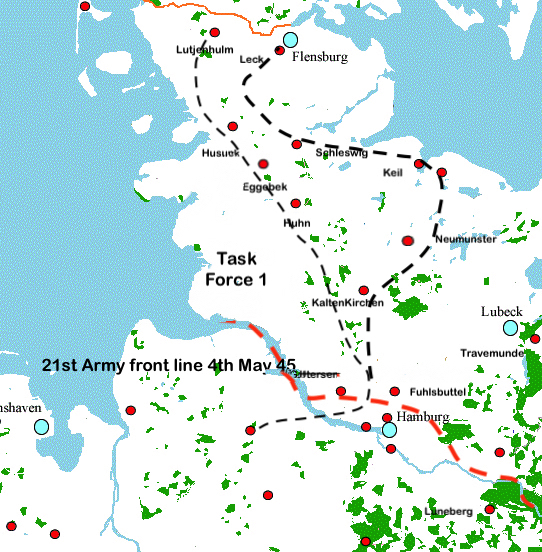
TF1 was ordered to take the most northern of the Airfield – Lutjenjolm astride the German / Danish border. There was little intelligence at what lay between Lt Col Casey’s Force and their objective, but after receiving the order to move at 20:00 on the 4th, 2809 AA Sqn was on the move before dawn the following day, despite being at a rear airfield and to have to replenish its fuel and other combat stores for the long journey of over 200 miles. Lt Col Casey made the decision that because of the length of the journey and the slowness of the Prime movers towing guns, he would divide his Force into Fast and Slow packets with the slow packets having all the heavy stuff and the Light Aid detachment to scoop up any vehicles that dropped out.
2809 had made good progress and by mid day was wending its way through Hamburg, as its start line for the journey North. Intelligence in Hamburg was none existent and so Casey’s Force proceeded North of the City. It rapidly became apparent that they were the first Allied troops into Schleswig Holstein as they increasingly encountered large columns of fully armed German troops. The fact that the vanguard of the British Army was led by the Royal Air Force was lost on the Germans who could not comprehend the irony. They seemed undecided, at times, either to allow the convoys to pass unhindered or stop them. On several occasions German Patrols would dive into ditches and take up fighting positions and then watch the convoy wander past, in wide-eyed amazement.
The Forward Recce Party under Fl Lt Giddings and 4 were pushing on towards Lutjenholm with great dispatch. They made great strides initially but were stopped short of Schleswig at a roadblock manned by German Fallschirmjaeger. He joined another party in a muscular discussion with the Paras who were firm in the opinion that a Truce had been enacted rather a surrender until things became clearer. Despite the documentation proving the surrender, the Paras, as Paras usually are, were adamant and unimpressed. The stalemate was only to be remedied by visiting their HQ in Schleswig. An officer was dispatched to try and sort out the impasse and the Recce party wisely repositioned their vehicles in order to make a quick getaway if the situation went south. After two hours of waiting the Officer returned with the news that the Para Commander had recognised that the War was, indeed, over and would allow safe passage to the Recce party. It was, however, conditional on the party taking the surrender of the town of Schleswig.
The Recce party dutifully moved off to Schleswig and formally accepted the surrender of the town. However, it silenced even the sharpest of Regiment wit when it was revealed that there were over 50, 000 troops garrisoned in the town. Nonplussed for some moments, a suitable solution was found with the former German Burgomeister and Commanders delegated authority over the town and its garrison and occupants. Having arranged a pragmatic and workable solution, the recce party pushed on to the objective.
Meanwhile, the Main Party had made solid progress on its alternative route that took it through Kiel, the home of the German Kriegsmarine (Navy). With great dash the party forced it way over the bridge in the won becoming the first British Troops to capture the German Navy HQ.
Rested up for the night the Task Force pushed on to its main objective the next day arriving early and seizing the airfields of Lutjenholm and Lock. Germans were disbanded and all stores seized. There were more than 66 Luftwaffe Aircraft on the base that were put together for security including two of the new Heinkel He 162 Komet rocket-powered interceptors. Secret documents and other intelligence treasure trove was also seized by the Squadron during their eagerly facilitated change of ownership.
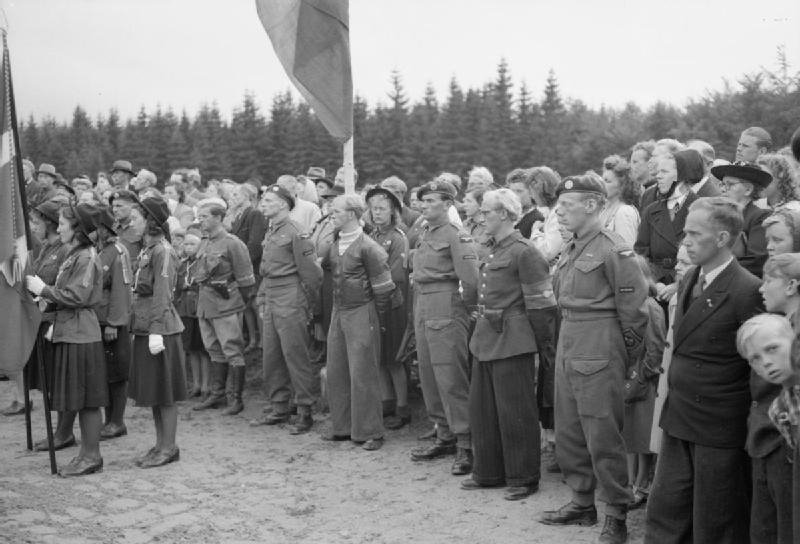
On the morning of the 7th May Fg Off’s Ketshie and Henderson were tasked with becoming the first British troops into Denmark by visiting the nearby town of Tondern. Equipped with motorcycles, the two Officers made their way towards the border. It was not plain sailing as the area was occupied by armoured units of the Waffen SS, who refused to allow them further progress. Despite many conversations, the two young officers finally made it to the final checkpoint on the German side, only to find it manned by SS troops and AFV’s. The pair had identified a small gap to one side as a rat run past the roadblock if the situation got worse. It looked more and more unfavourable, so the two young men went for it, through the small gap whilst the SS men were dumbfounded at their audacity. It was the last but one roadblock, the last being manned by the Danish Frontier Guards, who at first did not recognise the British uniform. However, it very soon turned into a huge celebration in the town for the Danes and the Regiment men. They were escorted to meet the mayor by a police car and welcomed by a guard of honour and a reception by the mayor where many gallons of Tuborg were drunk in celebration of the liberation Many photographs were taken and Anglo-Danish relations cemented in the ending of the Danes occupation.
 twozeroalpha