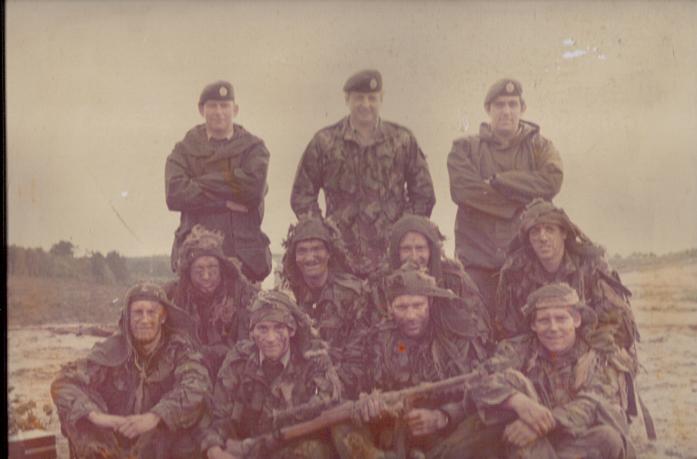
It’s strange to think that none of the accepted tomes of military recollections hardly ever includes the detail of training to fire one’s personal weapon. The relationship between the RAF Regiment Gunner and his rifle is symbiotic, it is part of him, part of his psyche. He is familiar with every scratch, scrape and blemish of its surface. He has kept it, swum with it, run with it and cleaned it, time after time after time. It works for him if he looks after it, a perfect training vehicle for a woman, except nothing, can train any man to cope with the distaff side of the race. I decided to punctuate my little stories with odd snippets of ranges after realising that some of the best episodes had been on ranges. It also lends itself to reminiscence because of the many and varied different ranges and training areas, ranging from a field in Belize where we stuck a few targets up and blazed away with our rifles for a good couple of hours, cathartic was not the word, to the delights of the Catterick and Feldom training areas and ranges in balmy North Yorkshire.
In the distant alleyways of my life there also loomed large an event that would reduce strong men to drink and weaker men to contemplate a future in a distant northern province of Canada, the Lloyds Cup. The premier shooting competition in the Corps was visited on us every single year and was a serious matter. At least it was a serious matter for our CO’s. It could spell the difference between a further promotion or the commencement of a search for a security managers job for De Beers or other such prestigious organisation. Organising such a shoot was also one of the two open chasms into which more junior officers could fall, the other being the Station Firework Display, which for some reason always went wrong (A modern day risk assessment in today’s Air Force would ban them completely).
As time has passed the manner of the conduct of the Lloyds Cup shoot has changed in line with the training methods. The Annual Personal Weapons Test was the last persona I recognised before my retirement and I have no doubt it will have changed since. The test mirrored the changes in range construction and the gradual arrival of technology on the scene of military training. When I was a lad it was known as the Phase 5 Rundown. This was as it stated running down from 300 yards to 100 yards and firing at the ranges in between. Then advancing the last few years to close with the enemy and kill him – the stated doctrine of all British infantry since Oudenard onwards. Every man jack on the squadron participated, even the flightless birds who fixed the wagons and did the leave passes and screwed up the radio sets. The average of all scores decided on the destination of the cup (and the officers promotion roster) each year. Simple really except the devil was in the detail or, to be more precise, in the range booking.
Every rock knows that ranges are not simply classified on their facilities for firing. Such intangibles as a good scoff, open all hours also helps, as does an uninterrupted supply of beer for those not unlucky enough to be planning ranges, prepping ranges or guarding everybody. Decent accommodation is not necessary for a good range camp, the tin huts at Willsworthy Camp spring to mind, where I once passed a week range firing on Dartmoor. Despite it being the height of summer in the rest of the UK, Willsworthy remained a universe apart with all 4 seasons often happening twice a day. Keeping dry and warm was important and the sole means of this were the coal stoves in each of the cattle sheds where we slept. As a consequence the troops went on the ranges smelling and looking like wee Geordie pitmen coming off shift down Paradise Drift. So ranges were a very complicated equation and not entirely recognised by the rules of the Lloyds Cup. The reason for this, I suppose was either a simplistic view of life or one of those officerly thoughts that good troops would manage to equalise any anomalies. Whatever the reason, the squadrons in the southern half of the UK always won it. Us lot in the north never had a chance despite being on the edge of one of the most extensive range complexes in Northern Europe. It was not unusual for the troops to deploy at the start line complete with scaling ladders and crampons for the ascent ahead. The names of those pleasure centers, like Deer Park and Whipperdale, fail to mask the long remembered pain of such days. Deer Park, in particular, was almost vertical between the start and finish. As the range was up hill, each individual firing point had to be built up so that the last 5 yards was 20 feet higher and actually had wee sets of steps cut into the side of the elevating mounds. By the time us unfortunates got to the firing point (under strict timing conditions) seeing the target became somewhat of a second prize to garnering enough oxygen into the lungs to sustain life.
Failing the delights of the Catterick range complex you might be unlucky enough to draw the reserve range at Battle Hills. I have been on many ranges in my life but the memories of Battle Hills is a horror story in a league of it’s own. It is the highest range in UK, above the A66 and the town of Brough. A winding road led in to the depths of northern Pennines but anything north of the entrance of the ranges was the marked on a fairly empty map as “here be tygers”. The range was dilapidated and the unfortunates who were wardens eked out their miserable pittance by dispatching all manner critters on adjoining homesteads. Range discipline was always difficult, with the range road in the centre, but the weather was always the killer. Battle Hills would be booked for 3 days for a shoot that normally would take half a day. Mist was the staple diet in reality low flying cloud. Range Officers would need runners to be able to see either end of the firing point and more than once I have seen a battle hardened young switched-on officer carted back to Catterick by land rover gibbering and frothing at the mouth after a session there. This was especially true if the mist lifted unexpectedly and he discovered he had been firing for ages with the butts flag up – and/or a couple of the range wardens wandering back into the butts after topping a couple of reluctant sheep at Cowheugh Farm just down the road, with the years mutton ration humped over their shoulders, waving to the troops. There was a huge inclination to turn their lights out permanently but common sense ( and large and wise NCO’s) guaranteed the continuance of their sheep husbandry activities.
Some of the other ranges, like the new-fangled ones with targets that didn’t need to be pasted up were beginning to appear at the end of the 60’s and more and more became common. Strangely the troops preferred the old Gallery Ranges with some hours being spent in the butts pasting out bullet holes with manky paste pots that had originally been created in the run up to Waterloo and the paste just replenished annually with some pungent rubbish. Small squares of different colours were the texture of the targets and god help you if you got a nit picker who could see from 300 yards away that you had put a ochre coloured patch on one that demanded a black one.
The most fun were on the field firing ranges like those at Otterburn or Sennybridge. Sennybridge is a name that strikes fear into most old rocks – a place of cold damp and wind, and that was just the billets. The 16th of Foot were encamped in Sennybridge, preparing for one of the many deployments overseas we got volunteered for and were honing up our battle shooting skills on an Individual CQB. This took the form of the usual recce patrol – you get separated from the rest of the patrol and have information that can save the Free World but you have to get it back to base through a mixed bag of Russian Spetznatz. In those days we had no electronic pop-ups and all the targets were used on a pull system with handles and levers and spindles, very effective but Heath Robinson. The guys who pulled the levers were protected by bunkers and were usually those of the Flight who were injured or more intellectually challenged. One of these, of Cro-Magnon lineage, was installed in the main target of the range, a crosser about 4 feet up over a stream. The routine was usually a SNCO and a gunner followed the hapless wight, who was being exercised, down the range. The SNCO controlled the range and the gunner carried the flags which indicated to the occupants of the target bunkers when to put their targets up and down – simples – hah!
I had gone down on one of the first runs and did my stuff well despite getting drowned when the crosser came up late and I had to take cover in the stream. Still I was top of the leader board and was grabbed by our Sergeant Mick, the Brummie, and I carried on from there. The boys had a good day and many plywood Spetznaz were dispatched with vigour but as the afternoon wore on one thing became very clear. Unless my mate, the google eyed Yorkie, could beat my score, I was going to win the kitty. We always had a kitty, it was a bit of an incentive, but the rules were complicated which never became apparent until it became complicated. Anyway, the other thing that was apparent was that Cro-Magnon man in the crosser pit was less than consistent. In fact he was like a black powder pistol, you pressed the trigger and felt the hammer go forward and then a wait of varying degrees whilst it sparked and another wait whilst the percussion cap was struck and it fired creating great amounts of pungent black smoke and a muzzle flame like an artists rendition of a man o’ war letting loose a broadside. A similar unreliabilty would manifest itself with Piltdown man stretching the time frame between the lever being located and it being pulled. It could vary between 10 seconds and a number of minutes and expletives. Yorkie had a secret, despite the outward appearance of a beer sodden wretch with Rugby League tendencies he was, in fact, a very good soldier, and, after getting his two mags of 7.62mm ( and swapping the odd round into the other mag – you didn’t think we were daft enough not to work out that two rounds per target meant you needed a even number of rounds in the box otherwise you got a stoppage in the middle of an engagement) cammed up and moved to the start line ready to boogie. Yorkies strategy was a bit like mine – pick your next cover and get to it asap. All went well, even the mag change negotiated until 2 targets from the end. A huge boulder gave some cover to get the breath back before crossing the stream, where the mover was located. The idea was to get the firer to fire one from the shoulder and one from kneeling as there was no cover at all. Off we went, the Yorkshire whirling Dervish moving at good pace when I get the signal to raise the mover. Green flag waving to where I know the bunker is – nothing happens. Yorkie is now into the stream and Mick is signalling to me – too late – out of arc, when the caveman lets go and down comes the mover. Yorkie executes a turn that would have had Jayne Torvill purring with professional pride and lets go a double tap – I stick the red flag up – the Fig 11 target rotates off the pulley and steel wire and there is the most horrendous scream from the bunker. As an experienced RCO myself in later years, I can only guess what was going through Micks mind. The prescribed drills were carried out – unloaded and cleared and I was dispatched forward to see what the damage was to Piltdown Man. As I got close all I could see was him on his back outside of his pit covered in claret, hands to his head. Out with the water bottle and sort him out sharp. The upshot :- Piltdown was not just dim, he was a lazy git as well and had got into the habit of wandering out of his pit so he could do some fancy handwork with the target which meant he didn’t have to patch the targets as he should have. The second of Yorky’s shots had hit the small pulley wheel at the top of the target completely destroying it so the target had spun around crashing down on Piltdown’s head splitting his head open and a small cut spewing forth his lifeblood. He never whinged about the pain after that first cry and the opinion on the flight was that it was a case of no sense no feeling. Anyway the end result was when the scores were added up and cogitated over in the back of the Bedford it was decided that the kitty (there is ALWAYS a kitty) would go to me for the best score, but as I was driving the Boss in the rover and was not there to collect it, I was disqualified and awarded to Yorky because of his flair and getting Piltdown. However, he was immediately disqualified because he hadn’t killed the slow witted numbskull and it was put into the pot for the nights festivities in the NAAFI.
 twozeroalpha