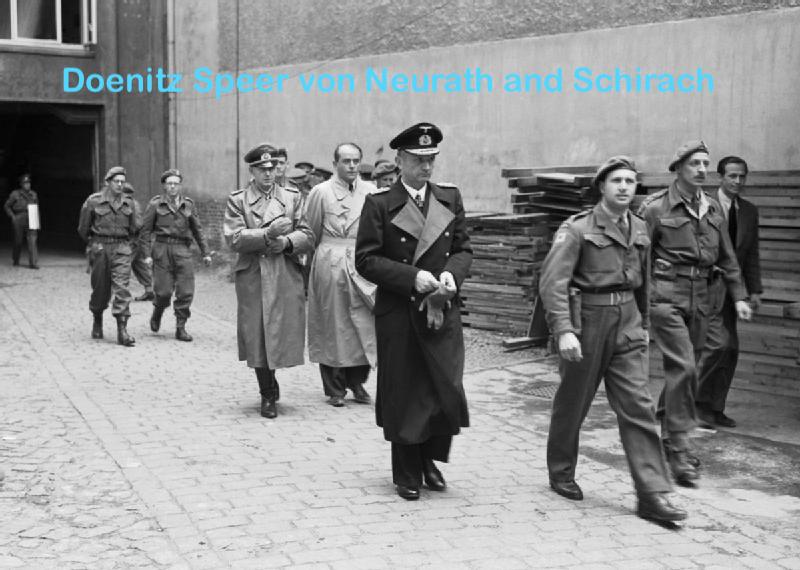
It is astonishing that the end of the war came so suddenly and quickly in 1945. On March 23 1945, 37 days before Adolf Hitler committed suicide, the Western allies were still in their Winter Quarters on the west bank of the Rhine. The winter had been a savage one even with the Ardennes Offensive and the subsequent air attack of Operation Bodenplatte on January 1. The Dutch population were trapped on the northern and eastern bank. The Russian Army led by Georgi Zukov had pushed relentlessly on with the Wehrmacht defending every inch of the German fatherland bloodily. Hitler’s General Staff knew, however, that a breech of the Rhine would spell the end for the 3rd Reich.
On the 23 March the British Canadians and Americans struck. In a stunning textbook land /air attack, the Rhine crossing was achieved near Xanten, 37 days later Hitler was dead, the Russians were in Berlin and the British Forces had occupied as far as the Elbe, Hamburg and up to the Baltic. Hitler named Admiral Doenitz as his successor as Chancellor, he formed a government and evacuated them to the northern German airbase at Flensburg. Doenitz’s strategy was simple – get as many of Germanys assets, personnel and materiel to the west so that they could surrender to the Western Allies and not the Russians.
The Army pushed forward against a beaten but not demoralised enemy, with understandably little appetite for risk taking at this late stage of the war. Small pockets of enemy were still fighting on, but RAF Air Intelligence were determined to get their hands on as much German technical equipment as possible and glean the secrets they held. There was also a huge number of German Servicemen to surrender, disarm and repatriate in Denmark and Norway should the German surrender be, as demanded, unconditional.
The RAF decided to push on ahead of the army and begin the task of ending the war and starting the peace, in a ruined continent after 6 years of devastation. 9 Task Forces(TF) from the RAF Regiment were launched ahead of the Army front line, to seize and hold airbases and take possession of the state of Schleswig – Holstein, the remainder of Denmark and Norway. It was possibly the most difficult task, in a war of extremely difficult tasks, that the RAF Regiment had faced. It tested relatively junior ranks with decisions that they had no precedent for. This is the story of one with others to follow.
Flensburg
One of these TF was tasked with seizing the base at Flensburg on the Baltic coast. Intelligence was unaware at the time that the entire surviving German Government was also on the base. At 03:30 in the morning of the 5th May, 2856 Sqn RAF Regiment were alerted to move as part of Lt Col Crabbe’s force to take the airfields of Flensburg and Lock. The objectives were:-
- Occupy and secure the bases
- Disarm the German defenders
- Prevent looting
- Protect equipment
Nothing in the orders alluded to taking the German Government prisoner. The Task Force was to be ready to move by 10:00hrs. The Bofors of 2856 were the major cause of the TF initial slow movement. The route was unknown – there were many diversions, the weather was ill favoured, and breakdowns were frequent. Nevertheless, by 13:35 the TF had crossed the Elbe and passed through Hamburg, with great difficulty because of the bomb damage. On leaving the city an air of determination was felt by the Gunners of the TF as they passed the last forward troops of the 7th Armoured Division – no more Allied troops were seen after this.
The TF covered 110 miles in the first day harbouring at a German residence and settled into night routine around 18:30. During the remainder of daylight hours the amount and variety of traffic pouring past towards Hamburg as ceaseless, with huge numbers of displaced people escaping.
05:00 hours the next day saw the TF moving again and began to encounter more and more armed Germans. Hobden’s Sqn encountered Soviet forces east of Travemunde . At Rendsburg they encountered a battalion of German paratroopers, in full battle order. The recce element of the task force’s quick-witted escape was only matched by the speed of acceleration of the jeeps exiting the Town Square. Their commander refused to accept that the end of the war was at hand. Hobden had fifty men with him and after an hour of ‘forthright discussion’, the German colonel gave way and Hobden’s small force crossed the bridge to resume its advance. Close to Schleswig, British POWs alerted the TF that there were SS in Flensburg who were not welcoming hosts. The TF proceeded further with its “war face on” and every weapon manned and ready, Flensburg appeared to be heavily garrisoned and there was an air of apprehension when it secured the airfield.
Flensburg was occupied by many thousands of troops from varying arms of the German Armed Forces including SS panzer groups and Paratroop units as well as Flak and Communications element. Lt Col Crabbe’s force of some 250 men were uncomfortable in the midst of several heavily armed German units – a FULL 16 hours ahead of the surrender time. After meeting with the base commander, the surrender of the base was secured, and disarmament commenced. 4000 Luftwaffe troops surrendered. The hostility of the surrendered bristled with every interaction between the Regiment teams and the Germans. All guards were swiftly replaced by Regiment gunners, all transport gathered into a central location and a no movement order lockdown implemented. Almost by chance Admiral Doenitz, Hitler’s appointed successor, was found and confined together with Albert Speer, Hitler’s production genius and the remainder of the War Cabinet.
At 17:50 Lt. Col Crabbe took 2 Flights further on to Lock where he took the surrender of almost 7000 troops and a full Squadron of the latest Me262 variant – Schwalbe (Swallow), the fighter variant.
Curiously it was not until the 23rd May, some 17 days after the TF had taken the base and detained Admiral Doenitz, that he and those below were arrested and charged with war crimes, due to negotiations with the Americans. Doenitz and Speer along with Schirach and Von Neurath were each sentenced to between 10 and 20 years imprisonment.
After occupying 16 airfields and securing the aircraft and equipment on them, the various RAF Regiment TF’s took the surrender of 50,000 Germans.
 twozeroalpha