Ranges – Sheep husbandry and the Lloyds Cup


It’s strange to think that none of the accepted tomes of military recollections hardly ever includes the detail of training to fire one’s personal weapon. The relationship between the RAF Regiment Gunner and his rifle is symbiotic, it is part of him, part of his psyche. He is familiar with every scratch, scrape and blemish of its surface. He has kept it, swum with it, run with it and cleaned it, time after time after time. It works for him if he looks after it, a perfect training vehicle for a woman, except nothing, can train any man to cope with the distaff side of the race. I decided to punctuate my little stories with odd snippets of ranges after realising that some of the best episodes had been on ranges. It also lends itself to reminiscence because of the many and varied different ranges and training areas, ranging from a field in Belize where we stuck a few targets up and blazed away with our rifles for a good couple of hours, cathartic was not the word, to the delights of the Catterick and Feldom training areas and ranges in balmy North Yorkshire.

In the distant alleyways of my life there also loomed large an event that would reduce strong men to drink and weaker men to contemplate a future in a distant northern province of Canada, the Lloyds Cup. The premier shooting competition in the Corps was visited on us every single year and was a serious matter. At least it was a serious matter for our CO’s. It could spell the difference between a further promotion or the commencement of a search for a security managers job for De Beers or other such prestigious organisation. Organising such a shoot was also one of the two open chasms into which more junior officers could fall, the other being the Station Firework Display, which for some reason always went wrong (A modern day risk assessment in today’s Air Force would ban them completely).

As time has passed the manner of the conduct of the Lloyds Cup shoot has changed in line with the training methods. The Annual Personal Weapons Test was the last persona I recognised before my retirement and I have no doubt it will have changed since. The test mirrored the changes in range construction and the gradual arrival of technology on the scene of military training. When I was a lad it was known as the Phase 5 Rundown. This was as it stated running down from 300 yards to 100 yards and firing at the ranges in between. Then advancing the last few years to close with the enemy and kill him – the stated doctrine of all British infantry since Oudenard onwards. Every man jack on the squadron participated, even the flightless birds who fixed the wagons and did the leave passes and screwed up the radio sets. The average of all scores decided on the destination of the cup (and the officers promotion roster) each year. Simple really except the devil was in the detail or, to be more precise, in the range booking.

Every rock knows that ranges are not simply classified on their facilities for firing. Such intangibles as a good scoff, open all hours also helps, as does an uninterrupted supply of beer for those not unlucky enough to be planning ranges, prepping ranges or guarding everybody. Decent accommodation is not necessary for a good range camp, the tin huts at Willsworthy Camp spring to mind, where I once passed a week range firing on Dartmoor. Despite it being the height of summer in the rest of the UK, Willsworthy remained a universe apart with all 4 seasons often happening twice a day. Keeping dry and warm was important and the sole means of this were the coal stoves in each of the cattle sheds where we slept. As a consequence the troops went on the ranges smelling and looking like wee Geordie pitmen coming off shift down Paradise Drift. So ranges were a very complicated equation and not entirely recognised by the rules of the Lloyds Cup. The reason for this, I suppose was either a simplistic view of life or one of those officerly thoughts that good troops would manage to equalise any anomalies. Whatever the reason, the squadrons in the southern half of the UK always won it. Us lot in the north never had a chance despite being on the edge of one of the most extensive range complexes in Northern Europe. It was not unusual for the troops to deploy at the start line complete with scaling ladders and crampons for the ascent ahead. The names of those pleasure centers, like Deer Park and Whipperdale, fail to mask the long remembered pain of such days. Deer Park, in particular, was almost vertical between the start and finish. As the range was up hill, each individual firing point had to be built up so that the last 5 yards was 20 feet higher and actually had wee sets of steps cut into the side of the elevating mounds. By the time us unfortunates got to the firing point (under strict timing conditions) seeing the target became somewhat of a second prize to garnering enough oxygen into the lungs to sustain life.

Failing the delights of the Catterick range complex you might be unlucky enough to draw the reserve range at Battle Hills. I have been on many ranges in my life but the memories of Battle Hills is a horror story in a league of it’s own. It is the highest range in UK, above the A66 and the town of Brough. A winding road led in to the depths of northern Pennines but anything north of the entrance of the ranges was the marked on a fairly empty map as “here be tygers”. The range was dilapidated and the unfortunates who were wardens eked out their miserable pittance by dispatching all manner critters on adjoining homesteads. Range discipline was always difficult, with the range road in the centre, but the weather was always the killer. Battle Hills would be booked for 3 days for a shoot that normally would take half a day. Mist was the staple diet in reality low flying cloud. Range Officers would need runners to be able to see either end of the firing point and more than once I have seen a battle hardened young switched-on officer carted back to Catterick by land rover gibbering and frothing at the mouth after a session there. This was especially true if the mist lifted unexpectedly and he discovered he had been firing for ages with the butts flag up – and/or a couple of the range wardens wandering back into the butts after topping a couple of reluctant sheep at Cowheugh Farm just down the road, with the years mutton ration humped over their shoulders, waving to the troops. There was a huge inclination to turn their lights out permanently but common sense ( and large and wise NCO’s) guaranteed the continuance of their sheep husbandry activities.

Some of the other ranges, like the new-fangled ones with targets that didn’t need to be pasted up were beginning to appear at the end of the 60’s and more and more became common. Strangely the troops preferred the old Gallery Ranges with some hours being spent in the butts pasting out bullet holes with manky paste pots that had originally been created in the run up to Waterloo and the paste just replenished annually with some pungent rubbish. Small squares of different colours were the texture of the targets and god help you if you got a nit picker who could see from 300 yards away that you had put a ochre coloured patch on one that demanded a black one.

The most fun were on the field firing ranges like those at Otterburn or Sennybridge. Sennybridge is a name that strikes fear into most old rocks – a place of cold damp and wind, and that was just the billets. The 16th of Foot were encamped in Sennybridge, preparing for one of the many deployments overseas we got volunteered for and were honing up our battle shooting skills on an Individual CQB. This took the form of the usual recce patrol – you get separated from the rest of the patrol and have information that can save the Free World but you have to get it back to base through a mixed bag of Russian Spetznatz. In those days we had no electronic pop-ups and all the targets were used on a pull system with handles and levers and spindles, very effective but Heath Robinson. The guys who pulled the levers were protected by bunkers and were usually those of the Flight who were injured or more intellectually challenged. One of these, of Cro-Magnon lineage, was installed in the main target of the range, a crosser about 4 feet up over a stream. The routine was usually a SNCO and a gunner followed the hapless wight, who was being exercised, down the range. The SNCO controlled the range and the gunner carried the flags which indicated to the occupants of the target bunkers when to put their targets up and down – simples – hah!

I had gone down on one of the first runs and did my stuff well despite getting drowned when the crosser came up late and I had to take cover in the stream. Still I was top of the leader board and was grabbed by our Sergeant Mick, the Brummie, and I carried on from there. The boys had a good day and many plywood Spetznaz were dispatched with vigour but as the afternoon wore on one thing became very clear. Unless my mate, the google eyed Yorkie, could beat my score, I was going to win the kitty. We always had a kitty, it was a bit of an incentive, but the rules were complicated which never became apparent until it became complicated. Anyway, the other thing that was apparent was that Cro-Magnon man in the crosser pit was less than consistent. In fact he was like a black powder pistol, you pressed the trigger and felt the hammer go forward and then a wait of varying degrees whilst it sparked and another wait whilst the percussion cap was struck and it fired creating great amounts of pungent black smoke and a muzzle flame like an artists rendition of a man o’ war letting loose a broadside. A similar unreliabilty would manifest itself with Piltdown man stretching the time frame between the lever being located and it being pulled. It could vary between 10 seconds and a number of minutes and expletives. Yorkie had a secret, despite the outward appearance of a beer sodden wretch with Rugby League tendencies he was, in fact, a very good soldier, and, after getting his two mags of 7.62mm ( and swapping the odd round into the other mag – you didn’t think we were daft enough not to work out that two rounds per target meant you needed a even number of rounds in the box otherwise you got a stoppage in the middle of an engagement) cammed up and moved to the start line ready to boogie. Yorkies strategy was a bit like mine – pick your next cover and get to it asap. All went well, even the mag change negotiated until 2 targets from the end. A huge boulder gave some cover to get the breath back before crossing the stream, where the mover was located. The idea was to get the firer to fire one from the shoulder and one from kneeling as there was no cover at all. Off we went, the Yorkshire whirling Dervish moving at good pace when I get the signal to raise the mover. Green flag waving to where I know the bunker is – nothing happens. Yorkie is now into the stream and Mick is signalling to me – too late – out of arc, when the caveman lets go and down comes the mover. Yorkie executes a turn that would have had Jayne Torvill purring with professional pride and lets go a double tap – I stick the red flag up – the Fig 11 target rotates off the pulley and steel wire and there is the most horrendous scream from the bunker. As an experienced RCO myself in later years, I can only guess what was going through Micks mind. The prescribed drills were carried out – unloaded and cleared and I was dispatched forward to see what the damage was to Piltdown Man. As I got close all I could see was him on his back outside of his pit covered in claret, hands to his head. Out with the water bottle and sort him out sharp. The upshot :- Piltdown was not just dim, he was a lazy git as well and had got into the habit of wandering out of his pit so he could do some fancy handwork with the target which meant he didn’t have to patch the targets as he should have. The second of Yorky’s shots had hit the small pulley wheel at the top of the target completely destroying it so the target had spun around crashing down on Piltdown’s head splitting his head open and a small cut spewing forth his lifeblood. He never whinged about the pain after that first cry and the opinion on the flight was that it was a case of no sense no feeling. Anyway the end result was when the scores were added up and cogitated over in the back of the Bedford it was decided that the kitty (there is ALWAYS a kitty) would go to me for the best score, but as I was driving the Boss in the rover and was not there to collect it, I was disqualified and awarded to Yorky because of his flair and getting Piltdown. However, he was immediately disqualified because he hadn’t killed the slow witted numbskull and it was put into the pot for the nights festivities in the NAAFI.
End Game Germany -1


It is astonishing that the end of the war came so suddenly and quickly in 1945.  On March 23 1945,  37 days before Adolf Hitler committed suicide, the Western allies were still in their Winter Quarters on the west bank of the Rhine.  The winter had been a savage one even with the Ardennes Offensive and the subsequent air attack of Operation Bodenplatte on January 1.  The Dutch population were trapped on the northern and eastern bank.  The Russian Army led by Georgi Zukov had pushed relentlessly on with the Wehrmacht defending every inch of the German fatherland bloodily.  Hitler’s General Staff knew, however, that a breech of the Rhine would spell the end for the 3rd Reich.

On the 23 March the British Canadians and Americans struck.  In a stunning textbook land /air attack, the Rhine crossing was achieved near Xanten, 37 days later Hitler was dead, the Russians were in Berlin and the British Forces had occupied as far as the Elbe, Hamburg and up to the Baltic. Hitler named Admiral Doenitz as his successor as Chancellor, he formed a government and evacuated them to the northern German airbase at Flensburg.  Doenitz’s strategy was simple – get as many of Germanys assets, personnel and materiel to the west so that they could surrender to the Western Allies and not the Russians.

The Army pushed forward against a beaten but not demoralised enemy, with understandably little appetite for risk taking at this late stage of the war.  Small pockets of enemy were still fighting on, but RAF Air Intelligence were determined to get their hands on as much German technical equipment as possible and glean the secrets they held.  There was also a huge number of German Servicemen to surrender, disarm and repatriate in Denmark and Norway should the German surrender be, as demanded, unconditional.  

The RAF decided to push on ahead of the army and begin the task of ending the war and starting the peace, in a ruined continent after 6 years of devastation.  9 Task Forces(TF) from the RAF Regiment were launched ahead of the Army front line, to seize and hold airbases and take possession of the state of Schleswig – Holstein, the remainder of Denmark and Norway.  It was possibly the most difficult task, in a war of extremely difficult tasks, that the RAF Regiment had faced.  It tested relatively junior ranks with decisions that they had no precedent for.  This is the story of one with others to follow.

Flensburg

One of these TF was tasked with seizing the base at Flensburg on the Baltic coast.  Intelligence was unaware at the time that the entire surviving German Government was also on the base.  At 03:30 in the morning of the 5th May, 2856 Sqn RAF Regiment were alerted to move as part of Lt Col Crabbe’s force to take the airfields of Flensburg and Lock.  The objectives were:-

  • Occupy and secure the bases
  • Disarm the German defenders
  • Prevent looting
  • Protect equipment

Nothing in the orders alluded to taking the German Government prisoner.  The Task Force was to be ready to move by 10:00hrs.  The Bofors of 2856 were the major cause of the TF initial slow movement.  The route was unknown – there were many diversions, the weather was ill favoured, and breakdowns were frequent.  Nevertheless, by 13:35 the TF had crossed the Elbe and passed through Hamburg, with great difficulty because of the bomb damage.  On leaving the city an air of determination was felt by the Gunners of the TF as they passed the last forward troops of the 7th Armoured Division – no more Allied troops were seen after this.

The TF covered 110 miles in the first day harbouring at a German residence and settled into night routine around 18:30. During the remainder of daylight hours the amount and variety of traffic pouring past towards Hamburg as ceaseless, with huge numbers of displaced people escaping.  

05:00 hours the next day saw the TF moving again and began to encounter more and more armed Germans.  Hobden’s Sqn encountered Soviet forces east of Travemunde . At Rendsburg they encountered a battalion of German paratroopers, in full battle order.  The recce element of the task force’s quick-witted escape was only matched by the speed of acceleration of the jeeps exiting the Town Square. Their commander refused to accept that the end of the war was at hand.  Hobden had fifty men with him and after an hour of ‘forthright discussion’, the German colonel gave way and Hobden’s small force crossed the bridge to resume its advance. Close to Schleswig, British POWs alerted the TF that there were SS in Flensburg who were not welcoming hosts.  The TF proceeded further with its “war face on” and every weapon manned and ready, Flensburg appeared to be heavily garrisoned and there was an air of apprehension when it secured the airfield. 

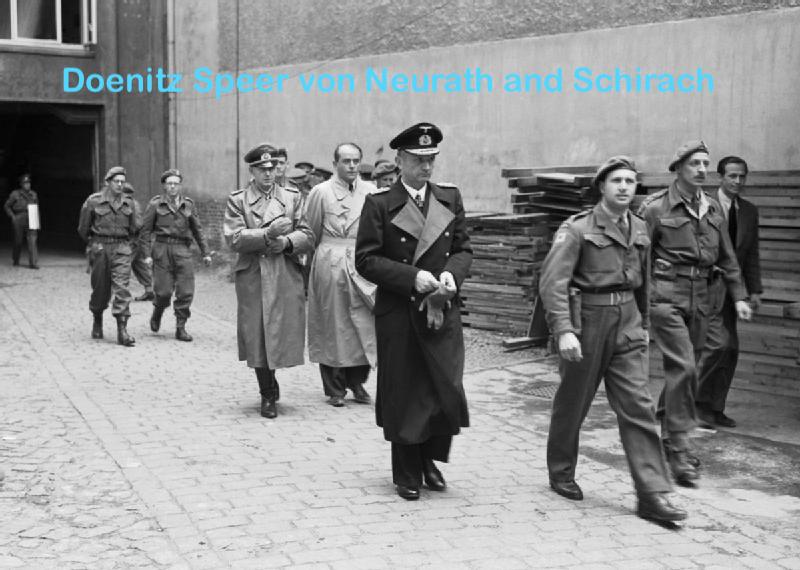
Flensburg was occupied by many thousands of troops from varying arms of the German Armed Forces including SS panzer groups and Paratroop units as well as Flak and Communications element.  Lt Col Crabbe’s force of some 250 men were uncomfortable in the midst of several heavily armed German units – a FULL 16 hours ahead of the surrender time.  After meeting with the base commander, the surrender of the base was secured, and disarmament commenced. 4000 Luftwaffe troops surrendered. The hostility of the surrendered bristled with every interaction between the Regiment teams and the Germans.  All guards were swiftly replaced by Regiment gunners, all transport gathered into a central location and a no movement order lockdown implemented.  Almost by chance Admiral Doenitz, Hitler’s appointed successor, was found and confined together with Albert Speer, Hitler’s production genius and the remainder of the War Cabinet.

At 17:50 Lt. Col Crabbe took 2 Flights further on to Lock where he took the surrender of almost 7000 troops and a full Squadron of the latest Me262 variant – Schwalbe (Swallow), the fighter variant. 

Curiously it was not until the 23rd May, some 17 days after the TF had taken the base and detained Admiral Doenitz, that he and those below were arrested and charged with war crimes, due to negotiations with the Americans. Doenitz and Speer along with Schirach and Von Neurath were each sentenced to between 10 and 20 years imprisonment.

After occupying 16 airfields and securing the aircraft and equipment on them, the various RAF Regiment TF’s took the surrender of 50,000 Germans.

Tales from the Gun Shed


The Curious case of Dr Tank and the Focke-Wulf takeover 1945

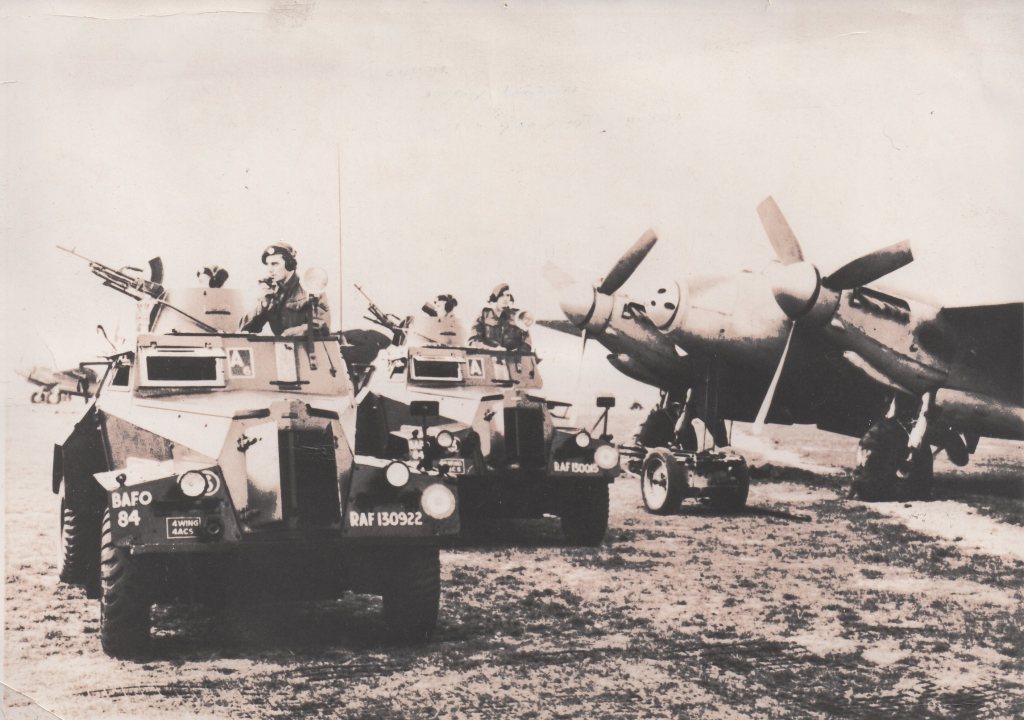
In March 1945 RAF Regiment units were pressing hard on the heels of the retreating German Forces.  In the main, their task was the securing of Luftwaffe bases, equipment and personnel before they could be destroyed and the possibilities for re-engineering or the gleaning of knowledge, be lost.  These units were often in front of their front-line army comrades, in what was a rapidly disintegrating German defence.  During the week 6-11th April 1945, British Forces in Northern Germany were dodging between strong but static German Military resistance and fleeing terrified Civpop.  The HQ of 2ATAF was the hub of the Allies air power in the North and the speed of the advance since the crossing of the Rhine in Kleve had accelerated the follow up, moves of the HQ.  Each move was reconnoitred in detail by a small party consisting of the HQ sigs and Intelligence Officers, Camp Commandant and some Regiment muscle for driving and FP.  Each move had conformed to this, so it was a surprise when the next and probably last move under war conditions was a major deviation from the pattern.  It had been decided that the best place for the new location would be the small town of Bad Eilsen, some 6 miles to the south and east of Minden.  The site would be the base for the main and TAC HQ during the occupation of Germany.  Operation WOOLWORTH, as the move was to be known, was to be a departure from the previous low risk moves where a location was cleared and bypassed 2 to 3 days before the recce party would visit it.  The Bad Eilson site was considered optimal for the occupation and so would be occupied as soon as possible after the Germans had been driven out.  It should be understood that the defenders in that area were WAFFEN SS Panzer grenadiers rated as the Germans crack troops.  To hold the town would therefore need a much larger force to hold it.  So in addition to the normal recce party the force would include 2 RAF Regiment Rifle Flights and an Armoured Flight with their Humber Mk 3 Scout Cars, No 5072K Mobile Signals Unit and a small RAF Bomb Disposal team to deal with mines and booby traps in the HQ’s proposed area.  The Operation was commanded by Wng Cmdr Nash RAF Regiment.

The task grouping crossed the start line at Suchelen at 16:00 on the 4th of April.  Fierce resistance was being encountered from locally directed forces and it took 4 days for the task group to finally weave its way into Bad Eilsen at around 11:30 on the 8th.  Two Humber Scout cars were held in the centre of the town and a third car went forward to investigate further.  Although fire was incoming most of the time it was neither regarded as significant nor threatening and the follow up Rifle Flights arrived and deployed around 13:30.  Meanwhile deeper in the town there were further robust discussions happening with the Humber AFV and a German stay behind party and the AFV arrived back in good order with prisoners and enemy dead.

Part of the intelligence brief for the Operation had indicated that the Hotel Bade was used as a conference facility for the Focke-Wulf aircraft company.   It was also noted reported that Dr Kurt Tank the Chief designer and the designer of the FW-190, Ta-152 (widely regarded as the best of the German Piston engine fighters) and the FW 200 Maritime Patrol and Reconnaissance aircraft had been seen in the vicinity of the Bade Hotel recently.  Wng Cmdr Nash was a great believer in asking straight questions so his inclination in this instance was to stop the first German civilian he saw and ask him where the Bade Hotel was.  He was informed politely that it was 200 yards up the road.  Nash then took the Signals, Int and Camp Commandant forward with him to the Hotel.  On reaching it, it was obvious that its previous function as a hotel was not what it was being used for at that time. Despite the density of the crowd the Officers pushed their way into the lobby and discovered on asking that the good Dr Tank was in his room on the 2nd Floor.  The party discovered in this room not only the design team but also aa goodly proportion of the board.  Dr Tank was arrested, and the rest ordered to leave and wait downstairs, which they complied to with alacrity.  Later it was discovered that there were significant quantities of arms and ammunition to have stood off the FP teams had they needed to assault the building.  The town was literally the R&D department for advanced jet and rocket powered fighter aircraft for the Luftwaffe and also hosted the drawing office.  It was a major coup for the Task Group as Tank was the lynchpin of Focke -Wulf’s new jet designs as he had been with their hugely effective and successful FW – 190 Shrike.  Settling in quite quickly the Officer bade Tank to have lunch prepared for them and designated his room as the Officers Mess.  The party then left the hotel located and arrested the Burgomeister and his deputy and by 16:30 had detailed the routine for the town and its inhabitants. Further reinforcements arrived in the form of two more army Daimler AV’s and two regiment rifle flights.  This gave the party enough to piquet all the approaches to the town although concerns that after 3 recce overflights in the early evening and the quality and quantity of the opposition on the nearby Autobahn, persuaded 2 ATAF to evacuate Dr Tank to a more solidly held piece of real estate near Buckeburg.

Dr Tank was flown out to UK soon after where after much negotiation he secured employment with the Argentine Air Force in design work, taking with him most of his Focke-Wulf design team.  Some years later he moved on to Hindustan Aviation, the Indian government sponsored Aircraft Development group, where he designed the Marut – the first Indian jet fighter which remained in service with the IAF until the middle 80’s.

For OPERATION WOOLWRTH, Wng Cmdr Nash, OC 1336 Mobile Wing RAF Regiment received a MID and a French Croix de Guerre, Flt Lt Spencer RAF Regiment an MID, a French Croix de Guerre and a Belgian Order of Leopold and Fg Officer Sixsmith, RAF Regiment, an MID.  The commander of the Armoured car detachment t of No 2804 Sqn RAF Regiment, Flt Lt Jay was awarded the Military Cross for his gallantry in this operation and in previous operations in extracting Forward Radars from under the German noses during the offensive in the Ardennes

The Fock-Wulf Company restarted, after its board meeting had temorarily been stopped by RAF Regiment interference, in the 50’s and after a series of mergers ended up as one of the founding partners of the Airbus consortium.

The Worlds Biggest Turd


Up Country Malaya – Kotta Tinggi, Jungle Warfare School out at Lombong Waterfall. My friend Yorky, with the google eye, has the bright idea of increasing the number of beer chits we get by volunteering us for the poo pit duty. 2 shillings and 11p a day for “objectionable duties” is not to be sneezed at, quoth he. So, every morning before we went off on training,  we had the signal honour of emptying the squadrons poo buckets, known as elsans, into a large pit, slinging some lime on it and depositing the correct amount of that blue poison Racasan into the new useable elsan. It could have been the heat or the lack of a copious amount of Tiger ( every time 15 organised the airdrop the palette with the beer on creamed in) but after a while Yorky started to take, what I thought was, an unhealthy interest, in the contents of said elsans. So I was not surprised when he appears at my side in the queue for breakfast (another advantage of the poo pit team, you went to the front)

“quick Geordie come and look at this, I found the worlds biggest turd(WBT)”.

Faced with a mess tine full of powdered egg, swimming in some form of liquid grease, I joined him and, sure enough, he had indeed snagged a monster. My little inner voice of caution started to murmur when he started to measure it and then using his gobbling rods(knife fork and spoon – KFS, in the parlance of the blanket stackers) carefully lifted it out for close examination. The only flat surface we had was the bonnet of OC 15 Sqns rover, all very spruce with a lovely white canvas cover for the spare wheel on the bonnet. Yorky then tastefully arranged the WBT into an arrangement like an upside-down ice cream cone on the white tyre cover. At that moment, Mick, our sergeant, grabbed me to go and draw the A43 ground to air radio set for the days training so I left Google Eye gloating over his prize. Perhaps my inner voice was turned down too far, anyway after a hard days training, standing in the cookhouse tent queue that night minding my business, the Sqn WO comes up and looks at me and Yorky and says “you two CO’s Tent NOW!” One didn’t argue with Big John and so we paraded at the CO’s tent. Piggy the CO came to the point quickly   “what sort of insult did you intend when you left that turd on OC 15’s vehicle”. I was starting to hear the inner voice hitting the loud pedal and listening to the gibbering loon going on about how long we had been on the crap house gang and imagining the end of a promising military career.  The loon dribbles on further about how we had taken time to make sure there was no one suffering from any foreign disease and inspected the output every day. Piggy was having a good day so we got a lecture about taking mundane duties too seriously and we could get out back to our meal

Result –  the inner voice shouted and I got as far as the tent flap before the CO asked Yorky which pit it came from – quick as a flash, the crafty one says “Officers toilets Sir” to which Piggy had a wee smile “out ,the pair of you”. I actually got my hand on the tent flap before the loon asks “Any idea what caused it sir?”

“For your information it was babies heads ( Ration packs steak and kidney pudding)
and Bacardi and coke” thus confirming it was his – so somewhere in the ulu north of Lombong waterfall lies the last resting place of the Worlds Biggest Turd where the dawn comes up like thunder – outer China – “crost the bay (with apologies to Kipling)

Up the Jungle 2


As a surprise consequence of the Worlds Biggest Turd, Yorky and I were removed from the chain gang by the CO on the grounds that he didn’t want to see 2 of his potential NCO’s ruined because they were keen. Returned to the Flight with a status of Rockstars, we got deeper and deeper into our training. People will talk about the hot countries and all that, but there is no shorter nor more efficient way of learning your trade as the jungle. Everything carried on your back, chlorined water, p*ss wet through all the time -sweat or rain, putting one foot in front of the other, next hill, next tin of Tom Piper Stew, next harbour. Our Flt Cmdr at the time shall remain nameless, not because he was a total dung head – he wasn’t, but because he turned out a great officer although on the Rapier side of the house and has remained a mate over almost 50 years. Well anyway, back to the plot – jungle harbouring drill were an essential for any field fight to master. Contrary to what I saw subsequently in Belize – nobody moved in the Malayan Jungle after dark. You went firm, sorted the harbour and comms out and waited for daylight, perfectly able to scramble the sh1t of anybody who strayed into your locale. Nothing difficult about the set up, 3 sections in a straight lines in a triangle – Gimpy at each apex, Flt HQ in the middle. Comms were always line pulls for silent stand to and a vine would be secured at chest height along the perimeter to indicate no further forward movement. Sections sorted out there own stags and hey presto not a problem. We all made basha’s, ground sheet and some sticks for the night. My problem this night was that I was on the HQ brick carrying the A41, rear link back to Sqn. Of course it would never work, it never worked at Feldom so there was no chance of it working in the ulu. Anyway we get set and I share the basha’s with the Flt Cmdr and the lines come in from the sections, just the usual green twine. One tug stand down, series of tugs stand to etc. All tested, we fed hard routine – no fires, water and tom piper stew cold – essence, eat your heart out Jamie Oliver. Settle down for the night and problem number 1 emerges, the Flt Com had cut the cord to length about 3 feet too short and they could only come to the radio op just outside the basha. By moving around I could get all three on my hand if my arm was outstretched. Still a minor discomfort – we settle down until about an hour after stand down, I hear a very light southern Irish accent saying Halt who goes there and a reply along the lines of friend, followed by a very pregnant pause and about 50 rounds from Ted Flints gun. No need for stand to the world had woken up. False alarm – one of the lemons had wandered outside the vine, been spotted by Paddy C and challenged. As Paddy explained later “For the life of me Sor, I couldn’t remember the password so I shot the bastard to be on the safe side” Rocks made sturdier choices in them days. Anyway it merely served to unnerve our young boss and throughout the night the flight was up and down, on stand to like a Penang Island hookers knickers. Problem Number 2 – because the cords were a little short, when himself whispered “Stand em to Esp” he leapt out of the basha and with unerring accuracy put his right foot in exactly the same spot every time – on my hand that was holding the comm cords. Reflex to pain – open your hand – cord shoots away in the dark and you spend the next half an hour finding it again. By the time you have found it its stand down, back in the Basha. After this had happened three times, I decided to mod the comms system, cut the cords about a yard long and tie the ends to the basha structure and the other end to the hand, which was now inside the basha and not getting used as a hog roast by every mossie in Malaya. Peace perfect peace for almost 5 hours until a couple of loud cries woke me and looking up I saw a large black shape obscuring the lightening sky. “he’s in the basha Esp Stop him!” Well you have to don’t you, young fit lad – boxer and quick, everything went into that right hook, connected wonderfully, like a four off the meat of the bat. Follow up – some nice rib shots, get the boot in and pin it to the floor yelling like a demented budgie “Got him Boss, got the evil bastard here” punctuated by another knee somewhere painful. Hands in the dark took over and Mick Roberts secured him as I panted, ” He got in the basha Sarge, Boss alerted me” to which Mick gently soothed me by saying “Esp, that is the Boss”. Oops a major specsavers moment, that earned me a night ambush with the Ghurkas. But that’s another story, to be continued.

An Irish Interlude – part 1 contd


The Clones Porker 

Pig What Pig?

Christmas Eve and we were getting tooled up to carry out the nights patrol activity.  We were officially  “Interdicting and disrupting the supply of terrorist material from the Republic”.  In reality, we would be harassing the Taigs as the Catholics were disparagingly called, coming back from midnight mass. Int  reminded us of the long standing smuggling rings in the area.  Operational Areas and Vehicle Check Point locations were suggested as were routes in and out of the areas.  Radio frequencies issued, however, as we all knew the patrol areas were so far away from base and the range of the steam driven radios we had was so limited that contact would intermittent at best and usually like being on the dark side the moon, in other words you were on your own.  Then came the big surprise of the night, we were deploying two teams in conjunction with the RUC B Specials.  And for once I would not make take my place as the Flight Sergeants driver, I was to command the second element of the patrol.  We operated with a 4 man team of ours and a 4 man police team at a specific location.  With me I had Dennis the purve, Brummy Frank as Sigs and another lad who could have been young Bill the plumber but may not have.  This was our usual team except for FS BBB.  He was not to be trifled  with as he stood over 6th 3ins tall in his socks and had served in all three of Her Majesties Services.  As a Royal Marine commando, he had been the Home Fleet heavyweight boxing champion in 1944 and the Home Fleet was a very big organisation then.  He was a pathfinder with the Guards Independent Para Company and had served 18 years in the RAF Regiment with a BEM to prove it.  One of the best men I ever served under.  He would shepherd the other 4 man team, some miles detached from us, with another group of B Specials.  This team we could contact by radio if anything went pear shaped.  At the end of our int brief we got another warning about smugglers not gun runners which didn’t surprise us at all seeing as what little intelligence we had from the area was supplied by the RUC and was very crime orientated with any terrorist int being years out of date.

Enforced rest from 3 to 5:30 was the order of the day and we duly had a quick ziz on the bunk beds we lived in for 6 weeks at a time.  My luck was to have a bottom bunk with Dennis the purve was above me where I could keep my eye on him.  I also found out that the troops get more sleep that the commander with all the admin stuff to do.  After a luscious mean of pork chop pasties and chips (don’t ask it casts aspersions on the skills of RAF cooks, but where else have you seen a whole pork chop including the bone encased in a pasty case and served, and the cook wondering why he had to move beds every night in case the guy who had bent his knife and lost a tooth trying to eat this, found him), we headed south east the 25 miles for Newtonbutler and then on towards the Cavan road.  The main area if interest was the concession road that ran from Clones through Northern Ireland and then back into the Republic.  The trick here was that duty on taxable items was not levied as the goods were deemed to be in transit between two locations in the Republic and technically not in Northern Ireland at all.  Well, even us intellectually challenged Rocks could spot the flaw in that one.  How do you know it goes south again if you don’t check it all the way?  Of course this was the smugglers route and they smuggled everything especially farm produce and diesel.  To us intrepid sons of Albion, this was a mere bagatelle, a distraction of getting to grips with the main task, the IRA.  Our B Special comrades agreed wholeheartedly and followed us eagerly in their small ford estate car. Now despite what was written about the B Specials in later years they did their stuff to the best of their training and capabilities.  The problem was the training started with the mantra “shoot first and then ask for their ID” and then degenerated swiftly – not the way we did it. 

So back to the start and the cold moonlit night west of Clones at around 23:30 hours.  Our Land-rover was parked in the on coming lane for vehicles coming across the border and the police vehicle behind it on the opposite side of the road creating a chicane of sorts which would not allow a speeder to race through the check point.  We had the two red faced farmer’s lads of the B Specials lying in the ditches on either side as a last resort if someone actually did crash the road block.  I and the sub Inspector occupied the middle of the road block with responsibility for stopping and searching cars, Frank was in the back of the rover on Sigs and Dennis was roving around looking for anything that took his fancy.  The Sub Inspector carried a Mark 5 Sten gun, seen in wartime films but not since then, with his lads with old single shot rifles.  He also carried a very small lamp who’s glass was almost completely blacked out with tape only allowing a pinprick of light to emerge.  When I asked him about this he stated that it was there so when (not if but when) the Papists didn’t stop they could open fire with justification.  This fed a faint twinge of alarm to my nervous system as I recall and all the memories of my Jesuit teachers and their lurid tales of Black and Tans flooded back in spades.  I told him we would use our super sexy 3 colour traffic torches which seemed to dampen his morale a little.  Nevertheless from around 12:30 onwards we started to get a steady stream of traffic coming from Clones after Mass.  The guys did the stuff and we logged them in and took names etc classic example of fighting men doing policeman’s duties and the Specials seemed to know everybody.  “Don’t bother searching that one Sor”, would be the word. “He’s one of us” and one didn’t have to be a PhD to deduce what that meant as they all strangely had Christian names like William, and Ian, not a Padraig or Declan to be seen. 

 Around 2AM things closed down completely and I got to thinking that we were probably the only people in Northern Ireland up at that time and was on the verge of calling it a day when another set of headlights lit up the hill in the distance.  “One more guys then we’ll call it a night”. This cheered everyone up.  The car approached on a weaving trajectory that could have taken it to Dublin one minute or into the front of the Police car the next.  Making sure we could get out of the way quickly we flagged it down and surprise surprise it stopped.  A very old Ford Popular (immediate post war equivalent of today’s Focus) with  a single occupant, a thin badly shaven individual of indeterminable age in somewhat tatty clothing.  The patois for this sort of meeting is standard

 “Good evening sir this is a British Military Roadblock can I see your driving license please?

pause 

Is this your car sir?

pause

What’s the registration number ?

pause

Would you mind getting out of the car so I can look in the boot?”

Simple really except when I looked at him I saw that the driver’s door was held on by a piece of string.  One of the characteristics of the Popular was the fact that their doors all hung from the central pillar.  This is the same as the rear doors of modern cars but their front door opened backwards unlike today. This meant he had a length of string stretching across the front of the windscreen hooked onto both doors.  It was also apparent that this guy was unimaginably drunk, pissed as a fiddlers bitch, 3 sheets to the mind, gassed to the wide, call it what you will, if he had breathed into a breathalyser he would have set it on fire. 

On the back seat of the car, as I looked in to its gloomy interior, were about 40 pint bottles of Porter, bottled Guinness.  This was looking decidedly dodgy and not according to the script.  So I tried again to get him out of the car and again he shook his head and dribbled.  Well, it was always hammered into us that the quality of the fighting man is determined by what he does when it doesn’t go according to the script, and our friend had committed the fatal error in opening the window slightly to hear me better.  Despite the alcoholic fug that was pure Bushmills wafting out of the window, I managed to get my hand inside the car and asked him once more if he would get out.  Another incomprehensible diatribe as he attempted to shut the window.

Well by this time I was becoming a pretty peed off teddy and the old Celtic blood was beginning to rise.  I pulled off the string that was keeping the door shut and opened it intending to extract the drunken leprechaun from the vehicle when I got another shock.  The string was there not just to keep the door closed, but as the hinges of that door had completely rusted through, it was there to keep the door on.  As soon as I opened it, it fell off, and onto the toe of the sub Inspector who promptly howled with pain and danced around like a whirling dervish in the middle of the road (to be honest he was a better actor than some preening Spanish midfield player). So there I was in the middle of this road freezing my nuts off, a broken car door in one hand and an RUC sub Inspector sounding like a gut shot water buffalo.  Logically I should have taken a deep breath in and counted to ten but it never goes like that and our friend, the fume breathing dwarf, found himself grasped and seized by the lapels and lifted out of the car where I said to him quite gently, “show me your f*****g driving license sunshine or I will break your arms and legs ….slowly and with malice”.  Reasonable in the circumstances I thought.  He managed to find a dog eared license from somewhere and he produced it with a giant burp that produced enough vaporized Alcohol to have poisoned half the population of County Cavan.  It transpired he was a local from Clones. And further questioning revealed he was on his was to his mother’s house in the Republic to spend Christmas Day with her. 

I now wanted shot of this comedian as soon as I could rid myself of him, so did the last part of the ritual, the look in the boot.  His face became a mask of fear when I asked him to open the boot.  “ Can’t do that, can’t open the boot”  Reasonably again I asked him what was in the boot, beginning to think we might have a live one here to which I got a shake of the head and some more Gaelic mumbling , or at least I think it was Gaelic.  So I did what any well trained military man would do – I growled at him.  I have a decent growl and it has frightened more than its fair share since that day but on its first operational deployment the growl produced some results.  “There’s a pig in the boot and you canna open it.”  A pig, I thought is just the sort of lunacy that would fit here and that’s why it doesn’t fit, how the hell he could get a pig in that small boot. 

This went on for some minutes with me asking “ What’s in the boot?” and him answering “ A Pig”  So I committed another cardinal error, I opened the boot lid myself.  The good book says you should always let the punter open their own boot, something to do with chain of evidence. Tiredness was getting to me, however, and I opened up the slanting boot lid.  Lo and behold, sitting in a cardboard box in the boot, was a small, round, pink pig.  Only it wasn’t there for long, sensing a way out of what must have been a very smelly boot, it made its dash for freedom and was away through the hedge into the field adjoining the road.  You might then have thought I had inflicted some form of horrendous torture on the driver as the wailing and whooping suddenly increased in volume and tempo to the top of the Beaufort scale. All that could be heard for probably 5 miles around was “ Ma Pig, Ma Pig, Ma Pig”.  Discretion is the better part of valour and I gave the hand signals to the troops to lift the VCP only to run into the nationalistic solidarity of the Sub Inspector who politely informed me that unless the vehicle and its cargo were restored to its previous condition, he would be forced to make a complaint against the squadron and me in particular.  At the same time, the drunken linty refused to sign the indemnity form.  It became obvious that we would have to apprehend said pig and stuff it back into the boot.  So Dennis the purve, myself and Frank the Brummy went into the field to catch the pig.  Simple job, I thought, just corner it, there are three of us, and close it down.  Have you ever tried to catch a small pig in a large field when its aroused?  Not one of life’s easier tasks, herding cats would be simpler.  After an hour of useless effort, the FS’s vehicle pulled up and he cast a sage eye over things.  A large grin on his face as was on the face of his driver, my best mate Rick.  He remarked that he was pleased I had everything under control and he would make sure that soup and a sandwich would be ready for us when we got back to base.  With that he leapt into the vehicle and away they went, accompanied by roars of laughter.  I was then more determined than ever to catch this pig, but after another 30 minutes of trying and having made no greater impression, I decided that drastic actions were justified and that if we could not catch the pig alive then a bacon joint it would become. 

The driver and the sub Inspector had been getting along famously whilst we had been slaving away in the field, primarily because the punter had broken open the porter and was sharing it with the Specials whilst sitting on the running board of the car watching us lot cavort around the field like the back markers in the National on the second circuit of Aintree.  I told the guys to get back to the truck and walked towards the pig.  As I did so I jacked a round into the breech of my rifle and I guess the pig and its owner saw the writing on the wall.  As I raised the rifle to aim, the old geezer reeled off some strange noises and whistles and the pig legged it, through the gap under the hedge next to the gate, to the back of the car and leapt into the boot and into its box whereupon it promptly lay down.

Nonplussed is a way to describe my feelings at that moment, I didn’t know whether to breath a sigh of relief or shoot the pig and its owner on the spot.  The Sub Inspector closed the boot and got the old git back into the vehicle and on its way, having a signed indemnity form.  As he drove away, the old fella left us 4 bottles of porter and his heartfelt thanks for the cabaret.  I gave it up and closed things down.  I would like to say we all recovered to base in good order but no – the police car would not start and we had to tow it back with the only tow rope available – our jointed rifle slings.  So ended the tale of the Clones Porker on a cold Christmas morning .   

Well not actually, some years later whilst engaged in waiting to down to Belfast during the Ulster Workers Strike we were passing the time murdering a bottle of Highland Park in the Royal Military Police Barracks at Aldergrove, Alexander Barracks or Ally Pally as it was known, and we got to talking about experiences with some of the Special Branch guys and the RMP SIB.  We talked about Enniskillen and how it had changed and one of the guys asked if we had not come across Mr W ****** on our ops there. He and his family had run a successful smuggling racket for years and that his main trick was to distract everyone from his cargo of contraband butter and fags by using his tame pig.  I would be lying if I said I didn’t change the subject very very quickly.


 …to be continued  Christmas in the Garage and jock Steels amazing mechanical Sausage