End Game Germany -1


It is astonishing that the end of the war came so suddenly and quickly in 1945.  On March 23 1945,  37 days before Adolf Hitler committed suicide, the Western allies were still in their Winter Quarters on the west bank of the Rhine.  The winter had been a savage one even with the Ardennes Offensive and the subsequent air attack of Operation Bodenplatte on January 1.  The Dutch population were trapped on the northern and eastern bank.  The Russian Army led by Georgi Zukov had pushed relentlessly on with the Wehrmacht defending every inch of the German fatherland bloodily.  Hitler’s General Staff knew, however, that a breech of the Rhine would spell the end for the 3rd Reich.

On the 23 March the British Canadians and Americans struck.  In a stunning textbook land /air attack, the Rhine crossing was achieved near Xanten, 37 days later Hitler was dead, the Russians were in Berlin and the British Forces had occupied as far as the Elbe, Hamburg and up to the Baltic. Hitler named Admiral Doenitz as his successor as Chancellor, he formed a government and evacuated them to the northern German airbase at Flensburg.  Doenitz’s strategy was simple – get as many of Germanys assets, personnel and materiel to the west so that they could surrender to the Western Allies and not the Russians.

The Army pushed forward against a beaten but not demoralised enemy, with understandably little appetite for risk taking at this late stage of the war.  Small pockets of enemy were still fighting on, but RAF Air Intelligence were determined to get their hands on as much German technical equipment as possible and glean the secrets they held.  There was also a huge number of German Servicemen to surrender, disarm and repatriate in Denmark and Norway should the German surrender be, as demanded, unconditional.  

The RAF decided to push on ahead of the army and begin the task of ending the war and starting the peace, in a ruined continent after 6 years of devastation.  9 Task Forces(TF) from the RAF Regiment were launched ahead of the Army front line, to seize and hold airbases and take possession of the state of Schleswig – Holstein, the remainder of Denmark and Norway.  It was possibly the most difficult task, in a war of extremely difficult tasks, that the RAF Regiment had faced.  It tested relatively junior ranks with decisions that they had no precedent for.  This is the story of one with others to follow.

Flensburg

One of these TF was tasked with seizing the base at Flensburg on the Baltic coast.  Intelligence was unaware at the time that the entire surviving German Government was also on the base.  At 03:30 in the morning of the 5th May, 2856 Sqn RAF Regiment were alerted to move as part of Lt Col Crabbe’s force to take the airfields of Flensburg and Lock.  The objectives were:-

  • Occupy and secure the bases
  • Disarm the German defenders
  • Prevent looting
  • Protect equipment

Nothing in the orders alluded to taking the German Government prisoner.  The Task Force was to be ready to move by 10:00hrs.  The Bofors of 2856 were the major cause of the TF initial slow movement.  The route was unknown – there were many diversions, the weather was ill favoured, and breakdowns were frequent.  Nevertheless, by 13:35 the TF had crossed the Elbe and passed through Hamburg, with great difficulty because of the bomb damage.  On leaving the city an air of determination was felt by the Gunners of the TF as they passed the last forward troops of the 7th Armoured Division – no more Allied troops were seen after this.

The TF covered 110 miles in the first day harbouring at a German residence and settled into night routine around 18:30. During the remainder of daylight hours the amount and variety of traffic pouring past towards Hamburg as ceaseless, with huge numbers of displaced people escaping.  

05:00 hours the next day saw the TF moving again and began to encounter more and more armed Germans.  Hobden’s Sqn encountered Soviet forces east of Travemunde . At Rendsburg they encountered a battalion of German paratroopers, in full battle order.  The recce element of the task force’s quick-witted escape was only matched by the speed of acceleration of the jeeps exiting the Town Square. Their commander refused to accept that the end of the war was at hand.  Hobden had fifty men with him and after an hour of ‘forthright discussion’, the German colonel gave way and Hobden’s small force crossed the bridge to resume its advance. Close to Schleswig, British POWs alerted the TF that there were SS in Flensburg who were not welcoming hosts.  The TF proceeded further with its “war face on” and every weapon manned and ready, Flensburg appeared to be heavily garrisoned and there was an air of apprehension when it secured the airfield. 

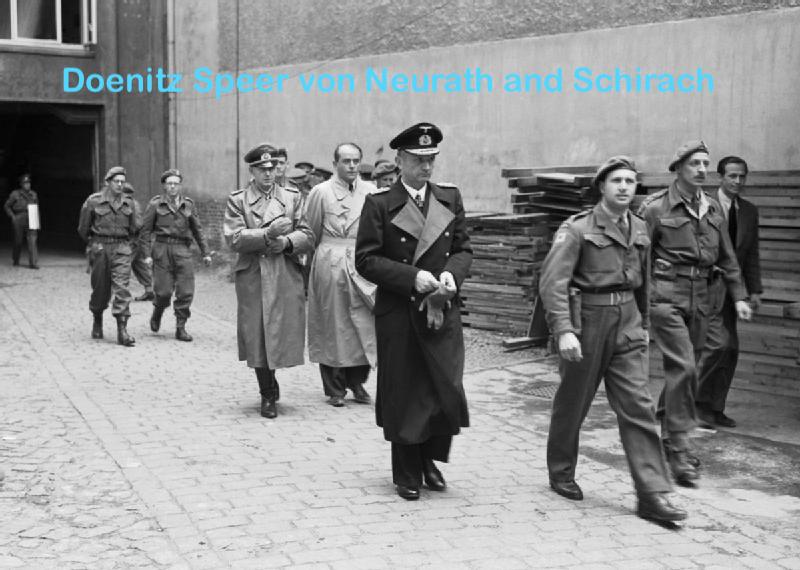
Flensburg was occupied by many thousands of troops from varying arms of the German Armed Forces including SS panzer groups and Paratroop units as well as Flak and Communications element.  Lt Col Crabbe’s force of some 250 men were uncomfortable in the midst of several heavily armed German units – a FULL 16 hours ahead of the surrender time.  After meeting with the base commander, the surrender of the base was secured, and disarmament commenced. 4000 Luftwaffe troops surrendered. The hostility of the surrendered bristled with every interaction between the Regiment teams and the Germans.  All guards were swiftly replaced by Regiment gunners, all transport gathered into a central location and a no movement order lockdown implemented.  Almost by chance Admiral Doenitz, Hitler’s appointed successor, was found and confined together with Albert Speer, Hitler’s production genius and the remainder of the War Cabinet.

At 17:50 Lt. Col Crabbe took 2 Flights further on to Lock where he took the surrender of almost 7000 troops and a full Squadron of the latest Me262 variant – Schwalbe (Swallow), the fighter variant. 

Curiously it was not until the 23rd May, some 17 days after the TF had taken the base and detained Admiral Doenitz, that he and those below were arrested and charged with war crimes, due to negotiations with the Americans. Doenitz and Speer along with Schirach and Von Neurath were each sentenced to between 10 and 20 years imprisonment.

After occupying 16 airfields and securing the aircraft and equipment on them, the various RAF Regiment TF’s took the surrender of 50,000 Germans.
Tales from the Gun Shed


The Curious case of Dr Tank and the Focke-Wulf takeover 1945

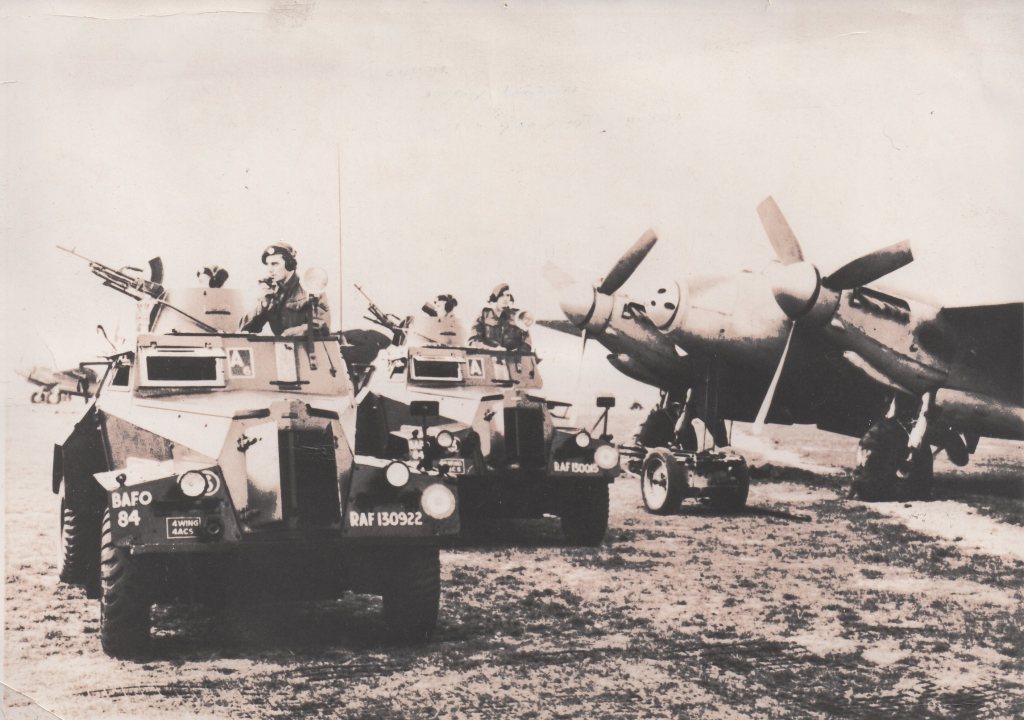
In March 1945 RAF Regiment units were pressing hard on the heels of the retreating German Forces.  In the main, their task was the securing of Luftwaffe bases, equipment and personnel before they could be destroyed and the possibilities for re-engineering or the gleaning of knowledge, be lost.  These units were often in front of their front-line army comrades, in what was a rapidly disintegrating German defence.  During the week 6-11th April 1945, British Forces in Northern Germany were dodging between strong but static German Military resistance and fleeing terrified Civpop.  The HQ of 2ATAF was the hub of the Allies air power in the North and the speed of the advance since the crossing of the Rhine in Kleve had accelerated the follow up, moves of the HQ.  Each move was reconnoitred in detail by a small party consisting of the HQ sigs and Intelligence Officers, Camp Commandant and some Regiment muscle for driving and FP.  Each move had conformed to this, so it was a surprise when the next and probably last move under war conditions was a major deviation from the pattern.  It had been decided that the best place for the new location would be the small town of Bad Eilsen, some 6 miles to the south and east of Minden.  The site would be the base for the main and TAC HQ during the occupation of Germany.  Operation WOOLWORTH, as the move was to be known, was to be a departure from the previous low risk moves where a location was cleared and bypassed 2 to 3 days before the recce party would visit it.  The Bad Eilson site was considered optimal for the occupation and so would be occupied as soon as possible after the Germans had been driven out.  It should be understood that the defenders in that area were WAFFEN SS Panzer grenadiers rated as the Germans crack troops.  To hold the town would therefore need a much larger force to hold it.  So in addition to the normal recce party the force would include 2 RAF Regiment Rifle Flights and an Armoured Flight with their Humber Mk 3 Scout Cars, No 5072K Mobile Signals Unit and a small RAF Bomb Disposal team to deal with mines and booby traps in the HQ’s proposed area.  The Operation was commanded by Wng Cmdr Nash RAF Regiment.

The task grouping crossed the start line at Suchelen at 16:00 on the 4th of April.  Fierce resistance was being encountered from locally directed forces and it took 4 days for the task group to finally weave its way into Bad Eilsen at around 11:30 on the 8th.  Two Humber Scout cars were held in the centre of the town and a third car went forward to investigate further.  Although fire was incoming most of the time it was neither regarded as significant nor threatening and the follow up Rifle Flights arrived and deployed around 13:30.  Meanwhile deeper in the town there were further robust discussions happening with the Humber AFV and a German stay behind party and the AFV arrived back in good order with prisoners and enemy dead.

Part of the intelligence brief for the Operation had indicated that the Hotel Bade was used as a conference facility for the Focke-Wulf aircraft company.   It was also noted reported that Dr Kurt Tank the Chief designer and the designer of the FW-190, Ta-152 (widely regarded as the best of the German Piston engine fighters) and the FW 200 Maritime Patrol and Reconnaissance aircraft had been seen in the vicinity of the Bade Hotel recently.  Wng Cmdr Nash was a great believer in asking straight questions so his inclination in this instance was to stop the first German civilian he saw and ask him where the Bade Hotel was.  He was informed politely that it was 200 yards up the road.  Nash then took the Signals, Int and Camp Commandant forward with him to the Hotel.  On reaching it, it was obvious that its previous function as a hotel was not what it was being used for at that time. Despite the density of the crowd the Officers pushed their way into the lobby and discovered on asking that the good Dr Tank was in his room on the 2nd Floor.  The party discovered in this room not only the design team but also aa goodly proportion of the board.  Dr Tank was arrested, and the rest ordered to leave and wait downstairs, which they complied to with alacrity.  Later it was discovered that there were significant quantities of arms and ammunition to have stood off the FP teams had they needed to assault the building.  The town was literally the R&D department for advanced jet and rocket powered fighter aircraft for the Luftwaffe and also hosted the drawing office.  It was a major coup for the Task Group as Tank was the lynchpin of Focke -Wulf’s new jet designs as he had been with their hugely effective and successful FW – 190 Shrike.  Settling in quite quickly the Officer bade Tank to have lunch prepared for them and designated his room as the Officers Mess.  The party then left the hotel located and arrested the Burgomeister and his deputy and by 16:30 had detailed the routine for the town and its inhabitants. Further reinforcements arrived in the form of two more army Daimler AV’s and two regiment rifle flights.  This gave the party enough to piquet all the approaches to the town although concerns that after 3 recce overflights in the early evening and the quality and quantity of the opposition on the nearby Autobahn, persuaded 2 ATAF to evacuate Dr Tank to a more solidly held piece of real estate near Buckeburg.

Dr Tank was flown out to UK soon after where after much negotiation he secured employment with the Argentine Air Force in design work, taking with him most of his Focke-Wulf design team.  Some years later he moved on to Hindustan Aviation, the Indian government sponsored Aircraft Development group, where he designed the Marut – the first Indian jet fighter which remained in service with the IAF until the middle 80’s.

For OPERATION WOOLWRTH, Wng Cmdr Nash, OC 1336 Mobile Wing RAF Regiment received a MID and a French Croix de Guerre, Flt Lt Spencer RAF Regiment an MID, a French Croix de Guerre and a Belgian Order of Leopold and Fg Officer Sixsmith, RAF Regiment, an MID.  The commander of the Armoured car detachment t of No 2804 Sqn RAF Regiment, Flt Lt Jay was awarded the Military Cross for his gallantry in this operation and in previous operations in extracting Forward Radars from under the German noses during the offensive in the Ardennes

The Fock-Wulf Company restarted, after its board meeting had temorarily been stopped by RAF Regiment interference, in the 50’s and after a series of mergers ended up as one of the founding partners of the Airbus consortium.